A Better Standard: Protect Safety Without Prolonging Family Separation
New York's family justice system must be capable of responding immediately when credible concerns about a child's safety are raised. Good-faith allegations of abuse, domestic violence, neglect, or other threats to safety must remain sufficient to petition the court and seek appropriate emergency protections. Families should never be discouraged from coming forward when they genuinely believe a child or family member is at risk.
But an allegation that justifies opening the courthouse door should not automatically become the standard for maintaining prolonged restrictions on a parent-child relationship.
The 2025 Family Court data demonstrate why timely evidentiary review matters. Of 61,392 statewide dispositions of original Family Offense petitions, 30,205 were dismissed and another 15,469 were withdrawn. Together, those categories account for approximately
74.4% of dispositions. Only 9,108 dispositions resulted in a Final Order of Protection.
At the same time, these cases are not necessarily resolved quickly. Statewide 2025 data show that 18,212 cases took 31–90 days to reach disposition, 12,631 took 91–180 days, and thousands continued beyond 180 days.
During that period, temporary orders and court restrictions can affect parent-child contact, depending on the circumstances and terms of the individual order. The state data do not establish that every child represented in these petitions was separated from a parent, so policy discussions should distinguish between cases involving actual separation and the total number of petitions.
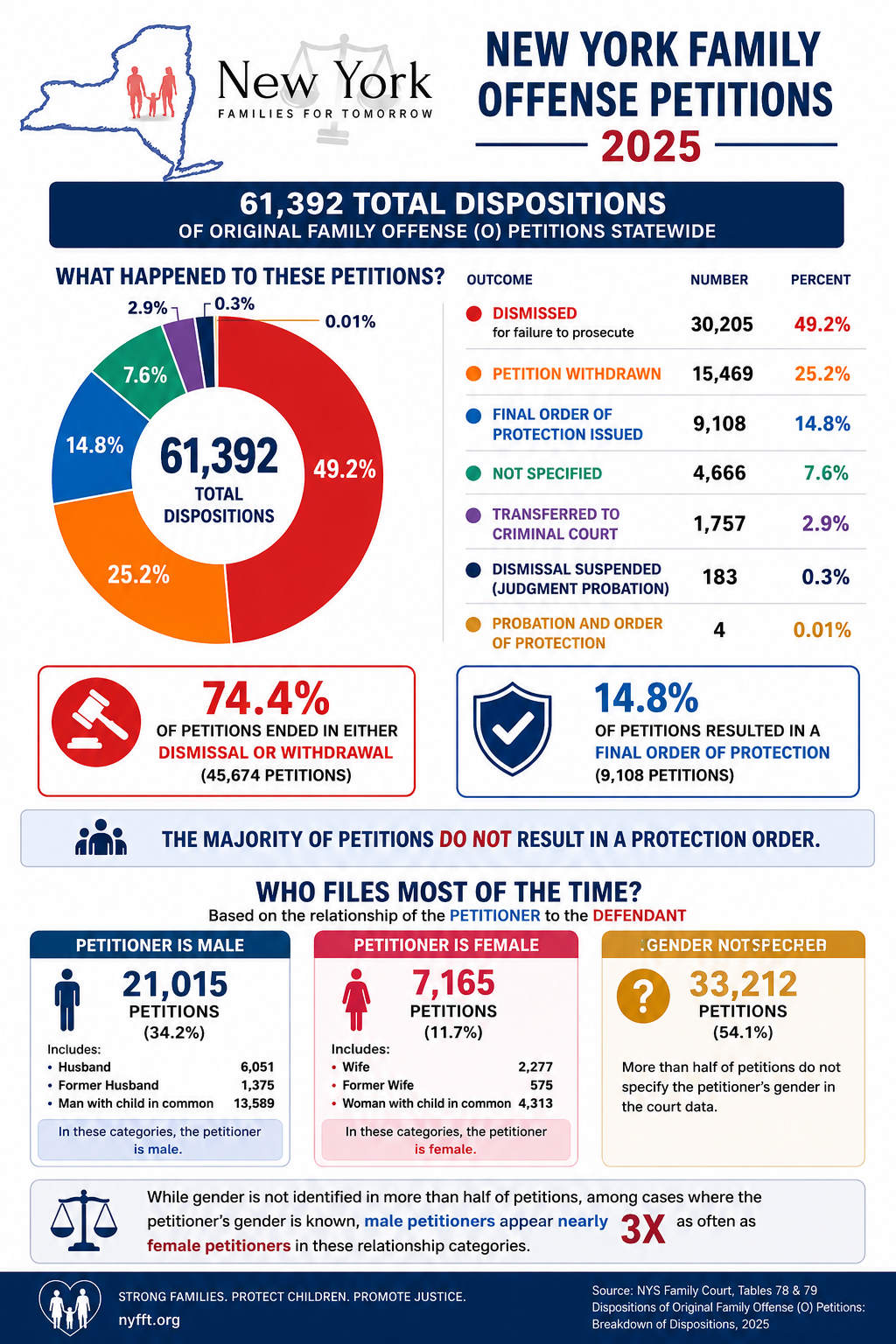
Data collected from the 2025 FCA reporting systems.
https://www.nycourts.gov/legacypdfs/court-research/FCA/FCA-2025.pdf
The Policy Solution
Good faith should be enough to raise an allegation. Evidence should be required to sustain prolonged family separation.
New York Families for Tomorrow supports a family justice framework that:
1. Preserves immediate access to protection.
Parents and family members acting in good faith must be able to bring legitimate safety concerns before the court without facing an unreasonable evidentiary burden simply to file a petition or obtain genuinely necessary emergency intervention.
2. Requires prompt evidentiary review.
When an initial order significantly restricts a parent's access to a child, the court should conduct a meaningful evidentiary review as quickly as practicable rather than allowing temporary arrangements to continue for months primarily because of court delay.
3. Establishes clear and convincing evidence as the standard for prolonged parent-child separation.
Emergency intervention and final adjudication are different stages. Once an initial emergency period has passed, NYFFT proposes that continued restrictions resulting in substantial parent-child separation should require clear and convincing evidence demonstrating that those restrictions remain necessary to protect the child.
4. Creates expedited timelines for cases affecting children.
Cases involving substantial restrictions on parent-child contact should receive priority scheduling, firm hearing deadlines, and active judicial case management. A temporary protective measure should not effectively become a long-term custody arrangement simply because the case remains unresolved.
5. Requires individualized safety findings.
Courts should distinguish between conflict, allegations, and demonstrated safety risks. Restrictions on parent-child contact should be narrowly tailored to the evidence presented and to the specific risk identified.
6. Restores meaningful contact promptly when the evidence does not support continued separation.
When allegations are withdrawn, dismissed, or insufficient to satisfy the applicable evidentiary standard, unnecessary restrictions on the parent-child relationship should be reviewed and lifted promptly, subject to any independent custody or safety determinations.
The Principle
Protect first. Investigate quickly. Require evidence. Decide promptly. Preserve the parent-child relationship whenever it can be maintained safely.
Child safety and due process are not competing principles. A system can provide immediate protection for credible, good-faith allegations while also recognizing that prolonged separation from a parent can carry serious consequences for a child.
The objective should not be to make Family Court harder to access. It should be to make temporary intervention truly temporary, evidence-based, and subject to timely judicial review.
When children's relationships with their parents are at stake, months of uncertainty should not substitute for evidence.